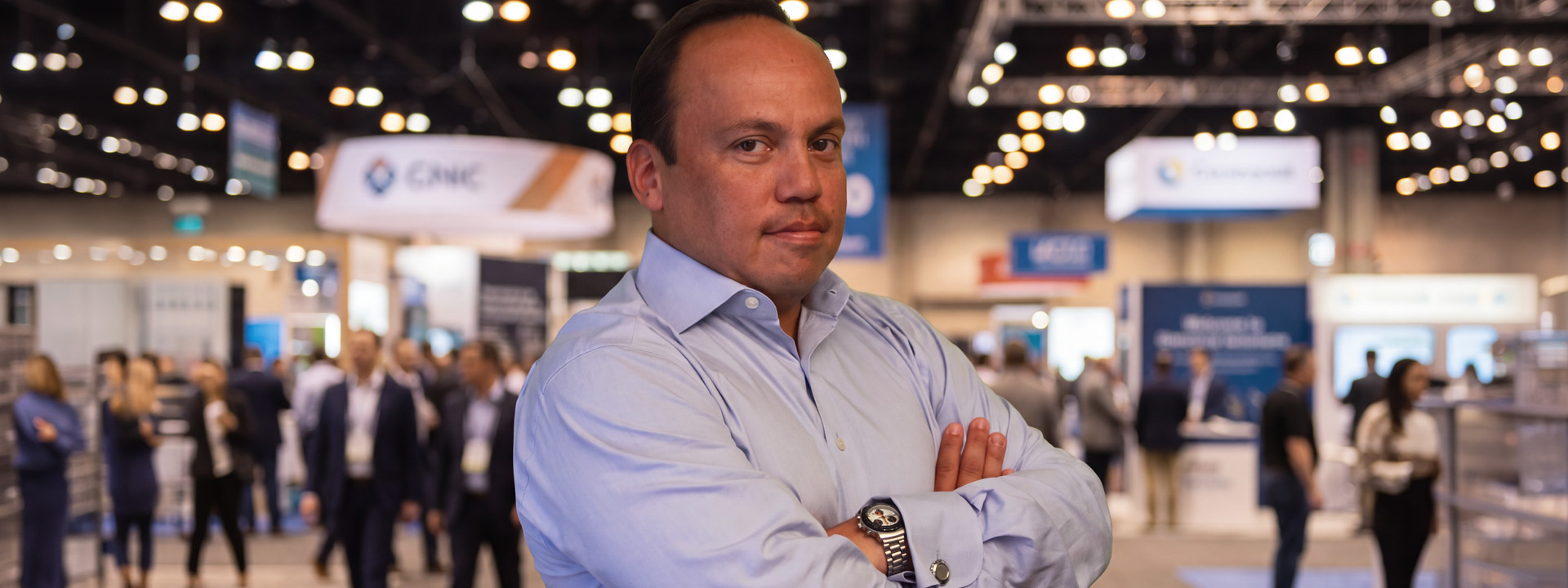
In energy and industrial B2B, the target of your marketing campaigns are rarely marketers. They're typically engineers, operators and technical leads who want technical substance. So what happens when you have a marketing agency whose COO started out as one of them?
Just ask Didier Germain, HexaGroup’s COO and a self-professed “engineer by design, marketer by pleasure.” We recently sat down with Didier to talk about career pivots, corporate lessons, and the marketing benefits of thinking like an engineer.
HexaGroup: Let’s start with a brief walkthrough of your early career. How did you get started in engineering and what compelled you to make the switch to marketing?
Didier: I worked for a logistics company in Paris, France for five years. After that, I worked for an oil and gas company, SLB, for 15 years between France and Houston. I have an engineering degree and an MBA.
While I was at SLB, I was exposed to all the different elements of upstream oil and gas. I was overseeing operations in terms of quality and processes. I always try to improve processes and I always try to bring new ideas, and at SLB I always had to market what I was doing internally. I had to craft messages about the projects I was working on. The projects were critical for the company because they were supporting the operations, so it was important that the message was going through to management and the field.
I was also very career-driven, and I wanted to do something that would feel like a good achievement. I’m also very creative, which is why I say I’m a ‘marketer by pleasure.’ I had known Arnaud [Dasprez, HexaGroup’s CEO] for a while. We first met in France when I was working with SLB. Later, when I came to Houston, I engaged a few HexaGroup team members for project work, so Arnaud and I had a good connection.
When I moved to HexaGroup, the agency was evolving from being just a web Technology and IT firm. The marketing function was just getting started. I saw it as a good opportunity to work in a different environment, start a new kind of career, and do what I’d always wanted: something more like entrepreneurship.
HexaGroup: What was the most difficult part of making the shift?
Didier: The hardest part was being accepted by the people already doing marketing. When you come in without that background, you’re basically a newbie, and they can see that you don’t know the field. So I had to prove myself using what I already knew, through specific projects where I could bring real value to the company.
HexaGroup: What lessons did you learn from your time at SLB that you apply at HexaGroup?
Didier: When I joined HexaGroup, the company was half the size it is now. At that size, it was fine to just roll with it. Our mindset was, “Okay, let’s do the work.” But as we grew, and growth was our objective, we needed a strong strategy. I took the best methods I had learned in the corporate world and implemented them at HexaGroup.
The goal was to grow the company while keeping its structure. A big part of that was making sure employees could see real benefits in training and career development. In a small company, you can feel like a career path doesn’t exist because there are only 10 of you. But it can still happen, and we needed to communicate this to the team and support their progress. So that’s what it was about: applying processes, along with people practices, to help us all grow.
HexaGroup: You’ve mentioned leading several major operations projects at SLB. What lessons did you take from that work, and how does that experience benefit HexaGroup clients with complex projects, particularly in the technology space?
Didier: If we look at size, the budget for that early project was about five times HexaGroup’s budget, so what we’re discussing was a lot bigger. It was also complex because it covered SLB’s entire upstream organization and its operations. I wasn’t talking to one person. I was working with about 10 different business lines, and that’s what made it complex.
But there are still lessons. One thing I learned, something we apply internally at HexaGroup, is that when we have a client in oil and gas or any other industry, it’s usually not one person we’re talking to. Our clients are generally big enough to have several business lines, and everyone is trying to get the best outcome for their own part of the company. Each person is pulling in their own direction. Not everyone is necessarily pulling the company up together. Sometimes there are little wars.
So it’s important to understand that context with the companies we work with, including internal dynamics. Sometimes you have to follow the client more closely because you feel you’re losing them, or you need to be more accommodating and include more people.
It’s all about being able to work with a client, being inclusive but also direct, so you can keep the relationship strong. I think that’s the most difficult thing with our clients: keeping them, and not only making them happy, but helping them grow as well. That’s our objective.
HexaGroup: You mentioned your international background as an expat. You’ve worked in many international markets, specifically on the oil and gas side. How does that influence your approach to marketing or to leadership?
Didier: At SLB, I was exposed to all the different elements of upstream oil and gas, as I was overseeing the operations in terms of quality and processes. I traveled to most of the world’s oil and gas countries and met people from different backgrounds.
In terms of marketing, it’s easy to think that because we are in the US, you have a US audience. But through my experience as an expat, and the people I work with, you realize they are not all Americans. You can’t craft messaging thinking it’s all for Americans because the decision makers are not necessarily Americans.
The decision makers at SLB are not all Americans. The decision makers at BP are not all Americans. All these companies have people coming from all over the world. So it’s important that we try to talk to all these people with different experiences. That’s the messaging side.
It also helps me with client relationships. Having an international background is something I’m trying to build into HexaGroup as well. I’m trying to build a team that is as diverse as our client base.
Something we didn’t touch on is that, at many of these companies, the marketing team is made up of engineers. So when I talk to them, I understand them and they understand me. I’m kind of the glue between their marketing team, who are actually engineers, and our team.
HexaGroup: That’s a perfect segue to the next topic we wanted to discuss with you, which is the engineering mindset. What can marketers learn from engineers?
Didier: What you can learn from engineers is this: Sometimes in B2B, we talk as if we’re talking to B2C, because we want to keep the message simple so people understand it and remember it.
That works to an extent, but with technical audiences you need to have the right nuance. Engineers actually like to talk technical, and they like their messaging to be a bit technical, too. So as marketers, we have to be careful that it doesn’t become completely marketing or completely technical. It has to be in the middle.
I think marketers sometimes take shortcuts by saying, “This technology is not interesting,” so we don’t put an emphasis on it. But the engineers doing marketing that we work with would feel better if we put more emphasis on the technology. They don’t always know how to explain it, so we need to help them do so.
HexaGroup: And then finally, what do you love most about marketing?
Didier: The biggest thing for me is being creative. The company is creative, and everything that we can do that is more creative will bring growth. That also means thinking out of the box.
What it means is that if you want to bring growth, there are plenty of techniques you can use. But that’s marginal growth. If you want to really grow, you buy a company and double your size. That’s one way of doing it. Or you have good ideas and you do things differently.
That’s what I like about marketing and how you grow: being creative so that you have ideas that are out of the box and different. These ideas are what help the client actually stand out from others and show a competitive difference.