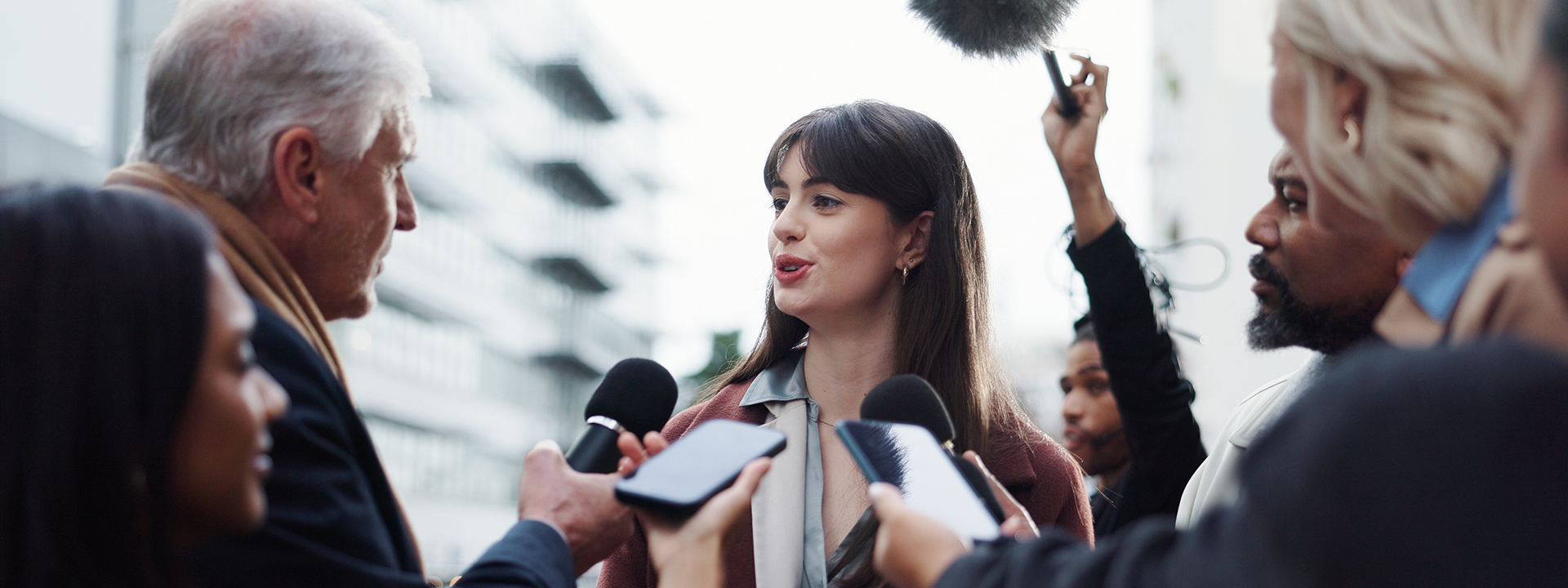
A crisis occurs. A reporter needs to speak to someone right away. You need to react. A written statement isn’t good enough. Someone within your organization needs to meet the media, which is going to ask tough questions, irrelevant questions, and even hostile questions.
How those questions are answered ties directly to the credibility of your organization. If your spokesperson isn’t properly trained, this make-or-break moment will more than likely have devastating results that can kill reputations, stall sales and, more importantly, keep the crisis circulating with the media and your key audiences.
If your spokesperson handles the interviews with confidence, clarity, and control, you’re in good shape. If they don’t, the outcome is already decided. Because media readiness isn’t about having something to say. It’s about knowing exactly how to say it when it matters most.
Most companies overestimate readiness
Ask any executive if they’re prepared to handle media interviews, and the answer is usually yes. They know their business. They know their numbers. They’ve done interviews before.
But media isn’t a knowledge test. It’s a performance environment.
And in that environment, different rules apply. The interviewer controls the direction. The audience controls perception. And the clock controls everything.
What sounds clear in a boardroom often becomes rambling on Zoom. What feels transparent internally can come across as evasive externally. That gap is where reputations are shaped, often in ways that aren’t immediately obvious.
The stakes are higher than ever
There was a time when media exposure was occasional and manageable. That time is gone.
Today, every interview lives on. It shows up in search results, circulates on social media, appears in investor research, and becomes part of how stakeholders understand your business.
One quote can travel farther than your entire communications strategy.
Scrutiny has increased across the board. Investors, journalists, employees, and the public are forming opinions quickly, often based on a single interaction. That means your spokesperson isn’t just representing your company in that moment. They are your company.
Preparation isn’t what you think it is
Most media prep focuses on information. Key messages, company facts, and industry context tend to dominate the conversation. That’s necessary, but it’s certainly not enough.
Real preparation goes deeper. It’s about whether your spokesperson can stay grounded when the conversation shifts unexpectedly. It’s about whether they can simplify complex ideas without losing credibility. It’s about whether they can respond to difficult questions without sounding defensive or uncertain.
Because the media rarely asks the question you hoped for. More often, they ask the question your audience is already thinking, especially in a crisis situation.
The difference between good and risky
There’s a version of media training that checks a box, and there’s a version that actually changes outcomes. You can hear the difference immediately.
A well-prepared spokesperson doesn’t just respond. They guide the conversation without forcing it. They stay composed even when the tone shifts. They understand that the real audience is not the person asking the question, but the people watching, reading, and forming opinions afterward.
Without that level of control, even a decent interview can introduce confusion or dilute your positioning. Nothing goes overtly wrong, but nothing clearly lands, either. And in media, that middle ground can be just as risky.
Silence is no longer a strategy
For a long time, companies could afford to stay quiet and wait for attention to pass. That’s no longer realistic.
If you don’t define your narrative, someone else will. And once that narrative takes hold, it becomes much harder to reshape.
Organizations that understand this invest early. They prepare their leaders before they’re under pressure, not in response to it. They treat communication as a core capability, not a reactive function.
Because when the moment comes, preparation isn’t something you can build overnight.
A simple test
If you’re unsure where your spokesperson stands, consider how they would handle a few very real scenarios.
Could they explain what your company does in a way that actually makes sense to someone outside your industry? Could they navigate a challenging or negative question without losing control of the message? Could they show up consistently across multiple interviews without changing tone or direction?
If there’s hesitation, there’s exposure.
Final thought
Media opportunities often look like visibility plays. In reality, they’re moments of trust. And trust isn’t built on what your spokesperson knows. It’s built on how they show up when it counts.
The question isn’t whether your organization will face the media. It’s whether, when that moment comes, your spokesperson is ready to represent more than just the facts.
At HexaGroup, we train corporate executives and assigned spokespersons to deliver effective on-brand messages to print, online, and broadcast media at the local, regional, national, and international levels. Our proven techniques help spokespersons represent their organizations in media interviews across multiple platforms.
> Take flight with our PR capabilities




.png?width=605&height=451&name=melissa%20groo%20flying%20bird%20(1).png)