


Last month, Timothée Chalamet released an 18-minute promotional video for his upcoming film Marty Supreme. The premise was simple: Chalamet joins his agency team on a Zoom call to share his "GREAT IDEAS" for promoting the Christmas Day release.
He wants to be on a Wheaties box. He has a theme color picked out—"hardcore orange"—and plans to paint both the Statue of Liberty and the Eiffel Tower in that exact shade. The session concludes in a 60-second team meditation on the values of "integration, culmination, and fruitionizing."
A little too real?
The agency team nods along. They take notes. Then, they approve everything.
The video is satire, but the discomfort it creates is real. If you’ve ever sat through a marketing meeting, you’ll likely recognize the dynamic immediately: tactics flying around the room like confetti, each one more theatrical than the last, while the fundamental questions remain unasked.
Who are we trying to reach?
What do we want them to think?
Why would any of this matter to them?
Chalamet didn't set out to drag marketers, but he exposed something most of us would rather not admit: Too many marketing plans look like that fictional call. A chaotic parade of ideas on a tightrope.
Marketing expert Mark Ritson watched the video and coined a term for what he saw: “tactification.”
What is tactification?
Tactification is the obsession with execution at the expense of strategy. It's the belief that marketing is nothing more than a collection of tactical activities: social posting, blimp flying, and yes, painting international monuments orange.
It's throwing pasta at the wall every minute and hoping a couple of noodles stick. That doesn’t make dinner ready faster; it just makes a mess.
The problem isn't that tactics are unimportant. They matter enormously. The problem is the sequence of events. When tactics come first, they become noise without direction. When strategy comes first, tactics become precision instruments.
Ritson points out that roughly 70% of American marketers have no formal marketing training. Most stumble into the profession from the consumer side and assume the discipline is just an array of activities to execute. They see the tip of the spear and mistake it for the entire weapon.
The result? Marketers are left with recycled “thought leadership” posts, cookie-cutter ABM plays, and endless social posts that are vanity projects—not needle movers.
A mirror we’d rather not look into
The brilliance of the Marty Supreme promo video isn't just that it's funny. It's that it's uncomfortably accurate.
Watch the agency team's faces as Chalamet pitches his ideas. They don't push back. They don't ask questions. They don't probe whether painting the Statue of Liberty orange will actually drive ticket sales or simply generate headlines that fade by Monday.
They nod. They smile. They say “very powerful.”
This is tactification operating in its purest form: a room full of people approving activities without questioning outcomes.
Consider what's missing from the thankfully fictional call.
No target audience. Who is this movie for? Arthouse film enthusiasts? Mainstream moviegoers? Sports fans drawn to the ping-pong angle? Chalamet never says, and no one asks.
No positioning. What should people think or feel about Marty Supreme? Is it a prestige drama? A crowd-pleaser? An awards contender? The brand identity remains undefined.
No KPIs. What does success look like? Opening weekend box office numbers? Awards buzz? Cultural conversation? Streaming performance after theatrical release? Without clear goals, there's no way to measure whether orange-painted monuments actually moved the needle.
No roadmap. The tactics exist in isolation, disconnected from any broader framework or system. A Wheaties box, international landmarks, and a meditation session don't add up to a plan. They're just an expensive shopping list.
No “Big Idea.” There’s no core creative concept that has legs and truly communicates something distinct and memorable about your brand across touchpoints and audiences for a long period of time.
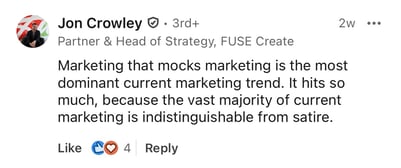
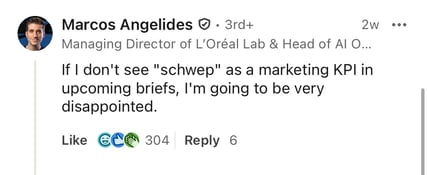
The video went viral because audiences recognized the absurdity. But here's the uncomfortable truth: The response from actual marketers suggested many saw themselves in that call. Some laughed in recognition. Others cringed at how closely it mirrored their own conference rooms. The line between satire and documentary turned out to be thinner than anyone wanted to admit.

Building on the foundation
The antidote to tactification isn't avoiding tactics. It's reversing the order of operations.
Proper marketing doesn't start with a brainstorm about what to create. It starts with understanding what already exists: the market, the competition, the customer, and the gap your brand can fill.
This is the work that happens before anyone picks a Pantone or books a billboard. It's less visible than execution, which is precisely why so many organizations skip it. Discovery doesn't photograph well. Strategy sessions don't make good Instagram content. But without solid data, every tactic becomes a guessing game.
As Ritson puts it, “Diagnosis informs strategy. Strategy directs tactics.”
When you reverse that order, you get the Chalamet call. A room full of people making noise, hoping volume compensates for direction.
Discovery and strategy: The foundation
Many organizations treat discovery as an obstacle between them and execution. A necessary evil. A box to check before the "real work" begins.
That mindset reveals the problem.
Consider a common scenario: A company decides it needs more brand awareness and concludes that social media is the answer. The request comes in tactical terms: "We need a stronger social presence. More posts. Better engagement. Can you help?"
It sounds reasonable until you ask a single strategic question: Where does your target audience actually spend their time and what type of content interests them as people?
If you're selling industrial equipment to procurement managers at energy companies, the answer probably isn't Instagram posts about compressors. Sure, your prospects might be scrolling reels during their lunch break, but they’re looking at fishing videos and home renovation tips, not compressor recommendations. If your content doesn’t reflect your audience as people, you’ve missed the boat.
A social media strategy isn't wrong because social media is bad. It's wrong if and when it's solving a problem that doesn't exist
That realization doesn't come from brainstorming tactics. It comes from research. Competitive and user data analysis. Customer interviews. Market positioning workshops.The unglamorous work of understanding the landscape before you try to stand out within it.
Discovery and strategy reveal what tactics can't: the difference between what you want to do and what will actually work.
Tactification: The real delay
The irony of tactification is that it promises speed but delivers chaos. It feels efficient to skip straight to execution. But when tactics aren't grounded in strategy, you end up redoing the work, chasing trends, or wondering why nothing seems to stick.
Discovery and strategy aren't luxuries for companies with unlimited budgets and patience. They're what generate bold ideas that actually stick. Competitive analysis reveals where the market has gaps. Customer research shows what actually matters to your buyers. Positioning work makes you focus on one thing—not a laundry list—that truly makes your brand distinct.
This work doesn't delay results. It ensures that when you do execute, you're building something that drives measurable results rather than creating noise that fades.
Built for results, not a flash in the pan
At HexaGroup, we work with B2B companies that are tired of executing marketing plans every year and getting the same results. Our process starts where it should: with discovery and strategy that reveal what actually matters before anyone picks a tactic.
After leveraging that legwork to develop bold ideas, we help you bring them to life through the Growth Engine, our precision engineered growth system. Think of it as the sweet spot where strategy meets execution and revenue ambitions come true—thanks to the combination of bold ideas and B2B growth best practices, not tactics for tactics’ sake.
If your marketing feels more like the Chalamet call than an engineered system, let's talk. Because growth is about doing what works.
Strategy first. Tactics second. Real results always.
Good to grow? Gauge your readiness in 10 minutes flat.
Unlock growth without boundaries
Need region-specific fresh eggs and flying lessons? Learn more about BBN, the agency that unites co-pilots from all corners of the sky.