This month's biggest energy stories revolve around the same tension: Companies everywhere are re-pricing risk. LNG importers are rewriting supply contracts, data center developers are hedging between gas and clean power, and SEO teams are rethinking what visibility means in the age of AI.
The throughline for marketers is to consider disruptions ahead of time rather than reacting to them. Foresight is becoming the real differentiator in procurement as much as in marketing. The companies making headlines this month are those that started building flexibility into their plans before they needed it.
In this edition, we explore how LNG buyers are hardening supply contracts after months of shipping disruption, why data centers are betting on both natural gas and clean power at once, and what a wild year of critical minerals pricing means for supply chain planning. We also explain how HexaGroup is borrowing brand-recovery lessons from a very unlikely source, why recruiting is becoming a marketing problem for energy employers, and what AI means for the future of B2B marketing on this month's HEX-Files podcast.
Let's dig in.
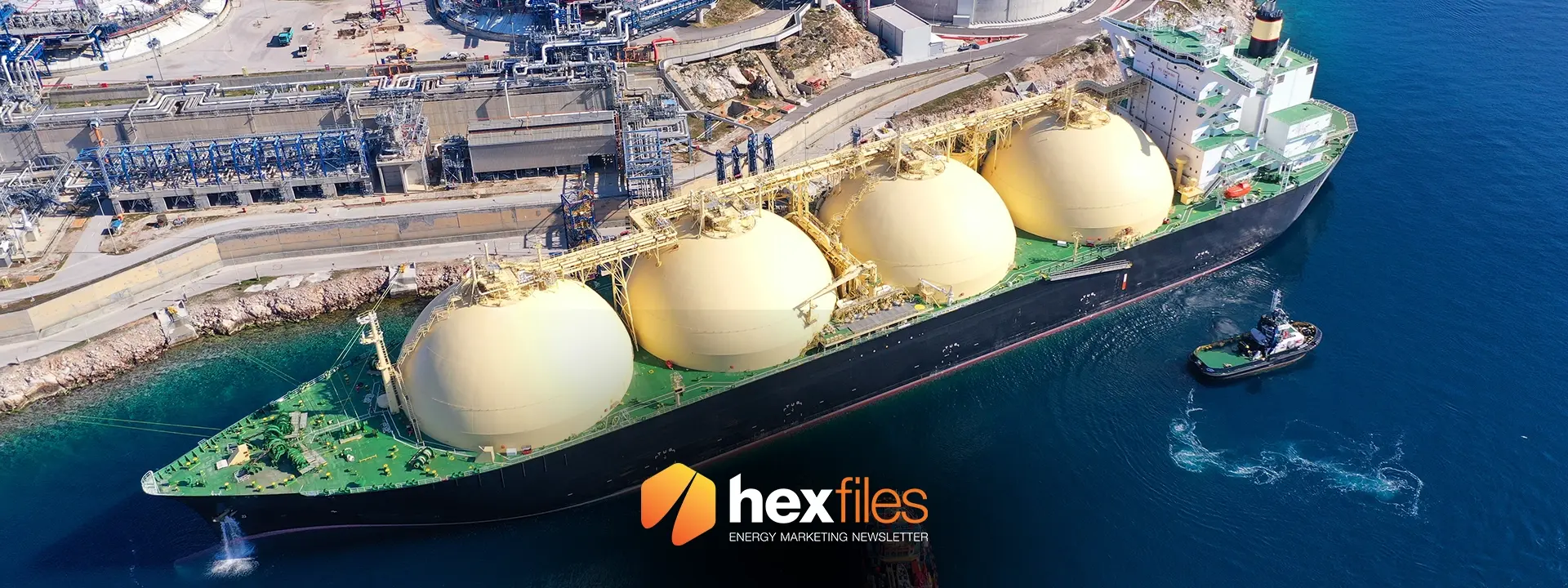
LNG buyers are rewriting the rules on supply risks
Since shipping disruptions through the Strait of Hormuz began earlier this year, McKinsey's latest pulse survey of LNG buyers finds a market rewriting its rulebook. Roughly 80% of buyers surveyed expect changes to their procurement strategy, and half expect the shift to be structural rather than temporary. Diversifying suppliers and geography tops the list of planned changes, cited by 93% of respondents, followed by stronger contractual protections, particularly around force majeure terms.
Buyers are putting money behind the shift: 66% say their companies are investing in resilience measures like storage infrastructure, shipping capacity, and floating regasification units. Confidence has not fully caught up with intent. Only about a quarter of buyers say their trading and risk-management capabilities are “fully sufficient” for the current level of volatility. This gap between strategy and execution will likely persist through 2027.
Impact on energy marketing
This is a story about how companies talk about risk, not just how they manage it. Buyers who can show they have diversified supply and hardened contracts have a genuine trust story to tell. PR teams in LNG-adjacent industries should build that narrative now rather than wait for the next disruption to force the conversation. The gap between stated intent and “fully sufficient” capability is also a warning. Overpromising resilience before it is built invites a credibility hit that is hard to walk back. The companies that earn coverage here will be the ones with specifics, not reassurance.
See the five survey charts >
Can you actually bring a dead brand back to life?
HexaGroup's latest blog is a Q&A with Director of Strategy Emily Hubbell and VP of Client Public Relations Mark Edwards on one of brand strategy's open questions: When a brand's reputation is damaged beyond repair, is resurrection ever possible?
The interview works through a range of cases and hypothetical crisis scenarios to test the line between smart and tone-deaf brand recovery. Hubbell and Edwards agree that the difference depends on whether the root cause of the damage is addressed with transparency.
Impact on energy marketing
Energy companies rarely face extreme crisis, but the underlying question of how much trust a damaged brand can rebuild, and with whom, is relevant to any company managing a safety incident, backlash over a rate hike, or a public regulatory fight. The most effective customer retention strategy is being honest about which segments are recoverable and which are not, then building the recovery plan around those that are. Brands that skip diagnosis and jump straight to rebranding often relearn this lesson the expensive way.
Read the full interview >
Data centers are quietly reviving America's gas plant pipeline
Planned gas-fired power capacity tied to data centers nearly doubled in the first half of 2026, according to Global Energy Monitor data cited by OilPrice.com. The U.S. now has 378 GW of gas-fired capacity under development. Of that, 189 GW is tied directly to data centers as Amazon, Microsoft, and Nvidia move forward with dedicated power plants to feed AI infrastructure. Texas is adding new proposals faster than anywhere else in the country.
Not all of it will get built. Turbine suppliers already face years-long lead times, and public opposition is mounting. A recent poll found roughly three-quarters of U.S. voters oppose new data centers in their area. Texas has already paused some new data center projects pending review, a sign that the buildout's pace may not be as guaranteed as the capacity numbers suggest.
Impact on energy marketing
This is a capital-cycle story. Sales and marketing teams selling into utilities, EPC firms or turbine manufacturers need to track the gap between “planned” and “built” capacity as closely as the headline numbers. Pipeline reporting that treats every announced gigawatt as a booked deal will overstate near-term revenue, and sales forecasts based on that assumption will miss. The more useful marketing story right now is about de-risking: separating projects that have secured permits, turbines, and community buy-in, from those that are still only announcements.
Read the full investigation >
AI changed what “getting found” means in B2B marketing
The latest HEX-Files episode features Ashley Emery, CMO of Velocity EHS, on how AI is disrupting organic search for B2B marketers. As more buyers get answers directly from AI tools instead of clicking through search results, Emery argues that marketers must shift their focus from traditional SEO to AEO (answer engine optimization), which is tailored to how large language models surface and cite information.
HexaGroup's early work in this area has revealed a similar pattern: brands cited by AI tools tend to have structured, source-attributed content and strong third-party mentions, not necessarily the highest search rankings. Emery also explains how her team aligns marketing and sales around shared pipeline and bookings metrics, and how EHS's internal account-based experience (ABX) program shapes retention and expansion across its 15,000-plus customers.
Impact on energy marketing
SEO and AEO are both critical for energy marketers today. Like the early days of SEO, AEO is still evolving quickly, and best practices will keep shifting for a while. Energy companies need to keep a finger on the pulse or partner with someone who does if they want to stay visible. Falling behind here means disappearing from the conversation entirely before a prospect ever reaches your site.
Watch the full episode >
Critical minerals prices just had their wildest year in a decade
The IEA's Global Critical Minerals Outlook 2026 finds that prices of battery materials and strategic minerals have swung sharply over the past 18 months as export controls have reshaped global supply. Lithium prices more than doubled due to strong demand from the energy storage sector. Cobalt rose roughly 130% after new export quotas from the Democratic Republic of the Congo. Tungsten prices surged sixfold amid new restrictions on strategic minor minerals.
Investment hasn't kept pace with volatility. Overall critical minerals investment fell 9% in 2025, the first decline in years, with the sharpest pullback in battery metals. Copper is the exception, drawing 8% more capital as confidence in long-term demand holds steady even as prices for other materials whipsaw.
Impact on energy marketing
Volatility like this changes how marketing budgets should be allocated in any company involved in the battery or grid supply chain. When mineral costs can double in a year, content and campaigns built around a specific price point or supply assumption quickly go stale. Budgets should shift toward evergreen thought leadership on resilience and diversification. It is also a moment when being first to explain “what this means for you” to customers and investors carries outsized value since most buyers are still trying to understand the new rules. Marketing teams that treat this as a one-time news cycle rather than a structural shift will be caught flat-footed at the next price swing.
Read the full outlook >
The skilled-trades shortage is really a branding problem
HexaGroup's latest blog argues that in today's tight labor market for skilled trades and technical roles, energy and industrial companies must treat recruiting as a marketing function, not just HR. It cites McKinsey research on the widening gap in critical trade skills and Deloitte's projection that up to 1.9 million manufacturing jobs could go unfilled through 2033 due to the ongoing talent shortage. Companies competing for the shrinking pool of qualified workers need a strong employer brand.
The piece outlines specific tactics, including treating candidate pipelines with the same discipline as a sales funnel and using content, not just compensation, to differentiate a company's story to prospective hires.
Impact on energy marketing
Recruiting budgets are chronically underfunded compared to the size of the problem that energy and industrial companies face. According to Built In's 2025 Talent Trend Report, employer branding ranks among the top three most effective recruiting channels for 40.3% of tech talent leaders. This puts it nearly on par with referrals and third-party job platforms. Treating the employer brand as a long-term marketing asset rather than a hiring-season tactic separates companies that consistently attract skilled trade and technical talent from those still scrambling.
Read the full playbook >
See You in October
From LNG contracts to AI search results, this month's stories all point in the same direction: The companies winning right now are the ones taking disruption into consideration before it hits, not scrambling to respond after. Take the GO Survey to see whether your growth engine can keep pace with what’s coming next.
We publish this roundup on the last Tuesday of every month, but new podcast episodes and energy insights drop weekly on the HexaGroup blog and LinkedIn.
Explore more energy insights >





.png?width=605&height=451&name=melissa%20groo%20flying%20bird%20(1).png)