Picture this: Georgia Tech and BYU’s football teams running through a giant Pop-Tarts wrapper to start the game. Marching bands with Pop-Tart trombone covers. A jacked, anthropomorphic Pop-Tart mascot proposing to someone in the stands. Commentators wearing Pop-Tart pocket squares. And the grand finale? An "annual sacrifice" where a Pop-Tart mascot literally gets devoured after going into the toaster to meet its demise.
This year's twist: one brave Pop-Tart–Slammin' Strawberry–jumped off the toaster to escape certain death, leaving behind only a cryptic sign: "You haven't seen the last of me!" A parody wanted poster with a $5,000 reward followed.
The internet, predictably, lost its mind. Social media exploded. Memes proliferated. News outlets covered it. Like the 2024 version, the 2025 Pop-Tarts Bowl became a cultural moment that transcended sports, all because a breakfast pastry brand committed fully to an absurd, memorable, impossible-to-ignore activation.
And the spectacle paid off. According to BleacherReport, “The Pop-Tarts Bowl has quickly become a sports and pop culture phenomenon ever since its inception in 2023. Fans clearly love the event, and that's evidenced by this year's viewership number of 8.7 million, which makes the 2025 bowl the most-watched non-College Football Playoff or New Year's Six bowl game since the Citrus Bowl on Jan. 1, 2020.”
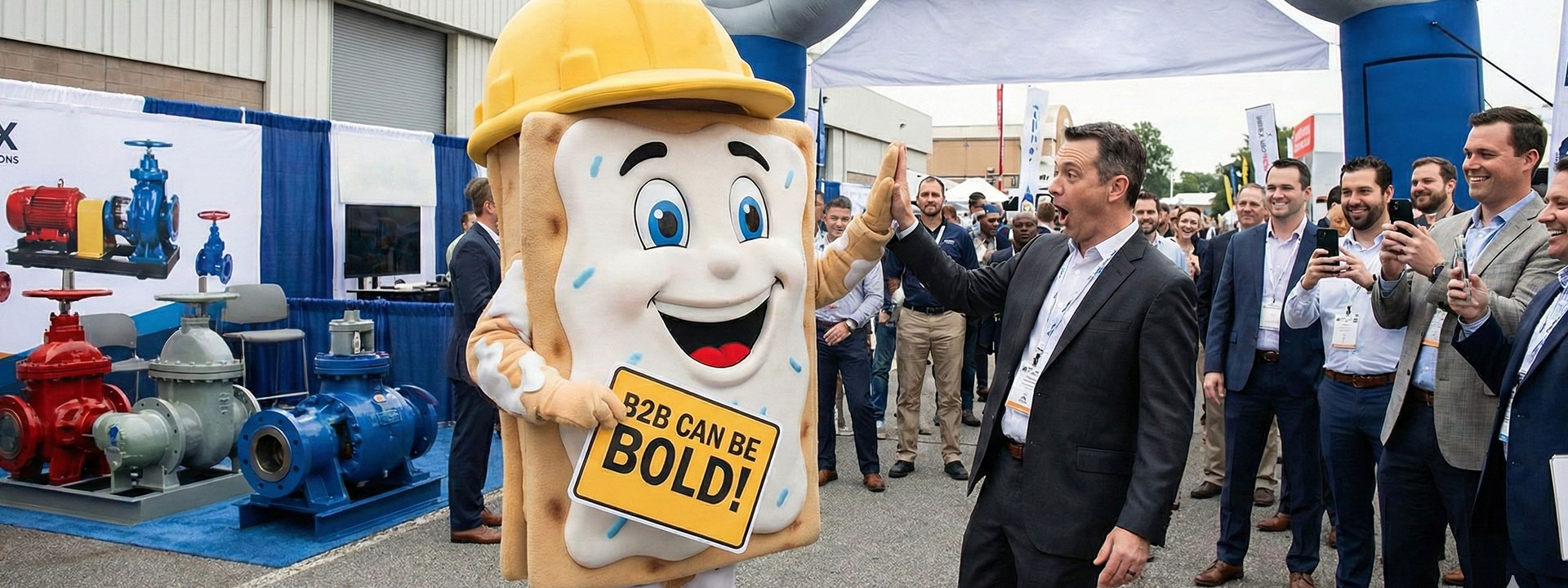
Now, you might be thinking: "That's great for Pop-Tarts, but I market oilfield equipment. We can't exactly sacrifice a mascot at a trade show."
Fair point. But here's the thing: The principles behind the Pop-Tarts Bowl's success apply to B2B marketing, especially as digital channels become increasingly noisy.
In a world where everyone is shouting digitally, the brands that also show up physically have a distinct advantage. The question is whether you're using those physical channels like everyone else or are willing to stand out.
Why traditional tactics matter more than ever
Let's address the elephant in the room: While absolutely an element of a solid strategy, digital marketing has become a crowded, competitive battlefield. Brands can still get significant returns from digital, but competition and saturation have never been more prevalent.
Paid social costs continue rising. Organic outreach keeps declining. Every B2B brand is fighting for the same LinkedIn impressions, the same Google Ad placements, the same inbox real estate. The digital marketplace is saturated, and most brands cannot afford to pay for all their visibility in this environment.
While this oversaturation is especially painful for B2B digital marketers, even B2C brands feel the heat. According to Cava CMO, “The biggest challenge—one shared across the industry—is breaking through the constant noise. Consumers are inundated with content every minute, and adding more noise isn’t the answer.”
Meanwhile, since the pandemic, the physical world has been getting quieter.
Fewer brands are investing meaningfully in events. Trade show booths have become largely generic and forgettable. Physical mailers often include boring branded swag that gets tossed immediately. Yet the competition for physical attention has arguably decreased, even as the competition for digital attention has skyrocketed.
“People are hungrier than ever to crave IRL things,” notes industry analyst Hackbarth, predicting that social and experiential marketing will become increasingly intertwined. “That noise and excitement is coming a lot more from physical than it is from digital.”
Case in point: Major conferences like the Offshore Technology Conference (OTC) continue to draw 30,000+ professionals annually, which allows it to maintain its position as one of the world's flagship energy trade shows. OTC is synonymous with robust technical programs and massive exhibition footprints spanning oil, gas, renewables, and offshore technologies.
Although quite different from a college football bowl game, conferences such as OSC still represent a critical opportunity for B2B companies. This is especially the case when they’re integrated with your digital strategy, not isolated from it.
In this digitally saturated world, in-person sales meetings, rather than virtual calls, are also an opportunity to be memorable to your customers. When everyone is only setting up Zoom meetings, showing up in person can send a huge message about commitment.
The Pop-Tarts Bowl was an absolute spectacle for all attendees and national television viewers. But the brand took this further by pairing the live event with a robust digital ad campaign around “edible mascots” and generating a ton of event content that was designed to be shared, reposted, and amplified online. Physical and digital worked together to create something bigger than either could achieve alone.
The metrics confirmed this: After the 2023 Pop-Tarts Bowl, Apex Marketing reported that the bowl generated $12.1 million in media exposure for the brand—a number that includes brand value from digital media, social media, TV, and radio.
For B2B brands in energy, industrial services, and other complex technical fields, mixing bold traditional tactics with digital strategy is one way to break through and boost brand exposure in a competitive market landscape.
Lesson 1: Commit fully to your event participation
The Pop-Tarts Bowl’s in-person element worked because Pop-Tarts didn't do things halfway. They didn't just slap their logo on a banner and call it sponsorship. They transformed the entire event into an immersive brand experience. Given their success, it’s no surprise that Cheez-It followed suit.
Half-measures get ignored. This is true whether you're sponsoring a college bowl game or exhibiting at tradeshows like OTC or TPS.
Think about the typical OTC trade show booth: a pull-up banner with your logo, some brochures on a table, a TV screen with a video on loop, maybe a bowl of candy. You're competing with 200 other booths doing the exact same thing. Why would anyone remember you?
Now imagine: What if your booth became an experience? What if you created something people actually wanted to participate in, photograph, and talk about?
This doesn't require a Super Bowl budget. It requires commitment to an idea and the courage to execute it fully. A well-designed interactive demonstration. A bold visual installation. A creative giveaway that people actually want (not another branded pen). A mobile hotspot for attendees who undoubtedly will require stronger Internet than is available at the venue. An offsite lounge where participants can refuel, recharge their devices, and meet other experts in a quieter setting.
The options are endless, and the principle is simple. If you're going to show up, show up all the way—in a way that delivers real impact for your target audience.
Lesson 2: Turn your pre, post, and during event into a content engine
Here's what made the Pop-Tarts Bowl brilliant: It was content waiting to be posted.
B2B brands consistently miss this opportunity. They treat events as one-day transactions: Show up, collect business cards, pack up, go home. No pre-event buzz. No during-event content creation. No post-event amplification. Some of this could be due to bandwidth or timing crunches, but too often it’s due to a lack of strategy.
What if you approached your next trade show differently?
Create a pre-event campaign that builds anticipation. Tease what you're unveiling with a digital invite. Give people a reason to visit your booth. During the event, capture content: conversations with attendees, demonstrations in action, expert interviews, and beyond. Post-event, turn that raw material into a short-form video and a blog post that you can share across social and in follow-up campaigns.
Then there’s the post-event lead management. Nurturing workflows are an essential tool for staying connected with the prospects you meet on the trade show floor. (Bonus points if these email workflows are personalized, automated, and paired with lead-scoring that triggers the right sales follow-up at the right time). Because let’s face it: Not every lead from an event is going to start out as a SQL, but the goal is to determine which meet that criteria and push them to the top of your sales team’s list.
Automated email nurturing and lead scoring help you pull that trigger for the right leads at the right time.
Lesson 3: Integrate your physical and digital tactics
The Pop-Tarts Bowl wasn't just a stadium spectacle; it was engineered for digital amplification. Every element—the jacked mascot, the proposal, the sacrifice, the escape—was designed to be photographed, recorded, shared, and discussed. The physical activation became digital fuel.
As a result, Pop-Tarts gained millions of impressions from people who never set foot in Camping World Stadium. But doing so required a lot more physical-digital integration than simply using the bowl’s official hashtag.
Most B2B event marketing initiatives fail because they treat physical and digital as separate channels instead of interconnected parts of one system.
Think about the typical trade show approach: You invest thousands in booth space, travel, and materials. You have great conversations. You collect business cards. Then... nothing. No media coverage during the event. No content captured for later use. No digital follow-up that references the physical experience. The ROI is limited to those three days and whoever happened to walk by your booth.
This translates from physical events to physical mailers as well. Your ABM mailers shouldn’t be a package sent into the void. Connect it so it can be measured:
- Include a personalized QR code that leads to a custom landing page and allows you to track when they view it
- Follow up with an email or LinkedIn message that references the physical package
- Create a video message that complements what the target received
The physical gets attention in an oversaturated digital world. The digital deepens engagement, provides additional meaningful touchpoints, and enhances measurability. Together, they create something more powerful than either tactic alone. Just ask Pop-Tarts, which, in addition to the $12.1 million in brand exposure across physical and digital, reported a 21 million to 22 million unit sales bump in the week following the 2023 bowl.
Stand out and integrate or blend in
The Pop-Tarts Bowl teaches us something essential: In a world of noise, memorable experiences win.
For B2B brands, this means rethinking how you approach traditional tactics. Events are about creating moments worth remembering and sharing, and mailers are about starting conversations that extend and are reinforced across digital channels. Traditional tactics are often underutilized opportunities in a noisy digital landscape.
You might not have a mascot to sacrifice (and honestly, HR would probably object). But you do have opportunities to stand out at every conference, in every sales meeting, and with every mailer. The question is whether you'll commit fully, create shareable moments, embrace bold tactics, and integrate physical and digital for maximum impact.
At HexaGroup, we help B2B firms build integrated growth systems where brand, marketing, sales, and service work in lockstep to create a measurable competitive advantage across the physical and digital worlds. Because the companies that thrive in competitive markets are the ones that learn how to engineer their way through.
Ready to build your own Growth Engine? Let's talk.



.png?width=605&height=451&name=melissa%20groo%20flying%20bird%20(1).png)