When we filmed a recruiting video at Borusan Mannesmann, one of the largest pipe manufacturers in the country, our talent was wearing a tropical button-down shirt. Flip-flops were on the table, but steel toes were on the feet. It was supposed to be playful, a little absurd, and very much not what you expect when someone says "pipe yard in Baytown.”
The recruiting video worked. And it worked for the exact reason you might assume it would have failed. The unexpected part was the point.
But here’s the thing nobody tells you about pulling off a creative shoot inside a working industrial facility: The reason we could land the tropical shirt gag, the reason we were invited back, and the reason the plant manager gave us the access we needed has almost nothing to do with the creative idea. It has everything to do with the 95% of the work that happened before a single frame was shot.
It starts with the schedule
Places like drilling rigs, refineries and manufacturing plants don’t stand still. A petrochemical complex is a living, breathing mix of cracking units, shift changes, and crane lifts. Every industrial site is different, but there’s one constant: Downtime is a four-letter word.
Nothing pauses or shuts down just because a film crew showed up. If a crew arrives thinking they’re the center of the universe, they’re going to be escorted to the gate by a frustrated foreman. That’s why the first skill of filming in these environments is scheduling. Actual, detailed, minute-by-minute pre-production work, built with the client's operations team and not imposed on them.
Before we pack a single case of gear, we lock the agenda with site ops. What areas are accessible? When and for how long? Is there a material handoff scheduled during our window? We coordinate around their logistics, not ours. If trucks move through the terminal every 15 minutes, we’re either working with that rhythm or we’re not filming there. Period.
We also build buffer time into our schedules because ultimately, something will shift. A permit will be delayed. A piece of equipment will be relocated. An unexpected safety drill will push the window.
The crews that produce great industrial content are the ones who treat the production schedule like an operational document. It’s not the most glamorous part of media production, but in the industries where we operate, it’s non-negotiable.
Safety isn’t a production consideration. It’s a precondition.
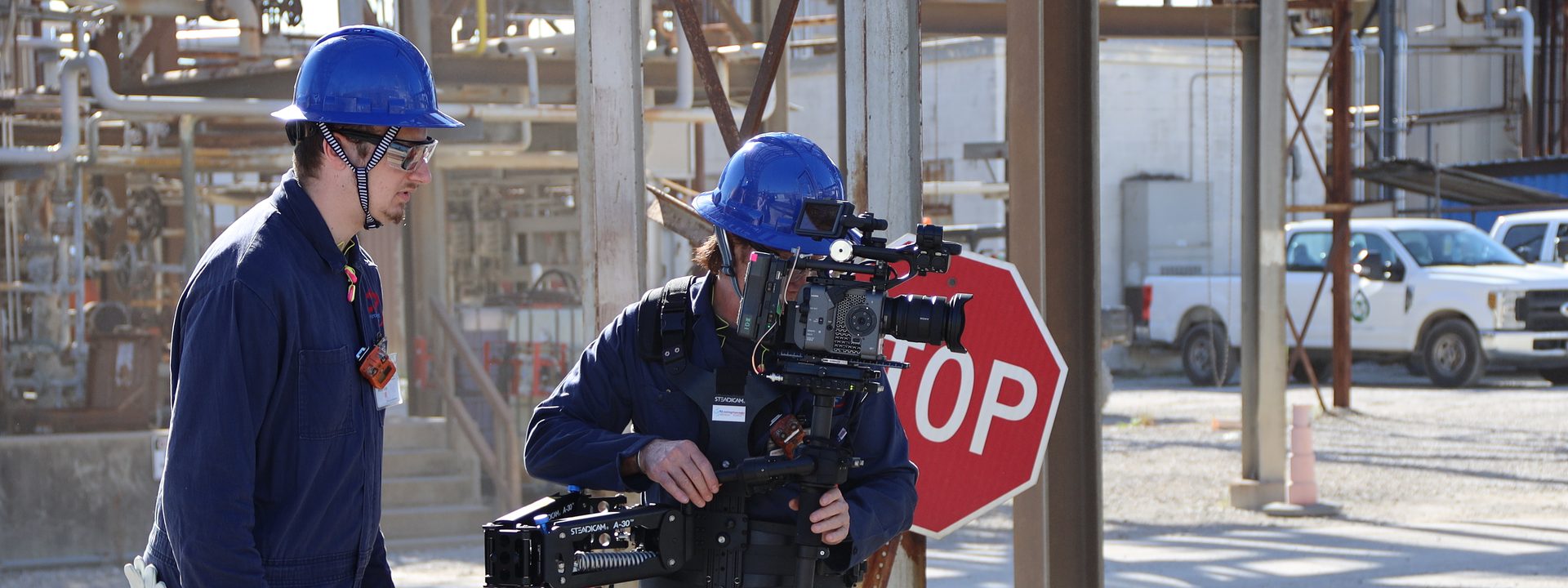
Before a single camera rolls, we have the safety conversation. There’s proper PPE for every person walking onto the site, not just the people in the frame.
A standard kit for a typical industrial shoot usually includes hard hats, safety glasses, hearing protection, steel-toed boots and high-visibility vests. If we’re near active welding—for instance, in a heat exchanger manufacturing facility—the risk profile shifts and so does the kit. Flame-resistant clothing comes in. If we’re near hot work, confined space entry, or blast zones, it shifts again.
Every site is different. Every scope is different. Site-specific inductions happen every single time, for every member of the crew. No exceptions. Think of these as akin to those mandatory pre-flight safety presentations, except that there’s no putting on headphones or zoning out. Everyone listens and actively participates.
We also use these meetings to talk about no-go zones, emergency muster points, and who the site's safety contact is if something goes wrong. We don’t expect it to; we’ve done this dozens of times without incident. But the people running the plant need to know we treat their environment with the same seriousness they do—even if the video concept itself is humorous or lighthearted.
You’re not learning on your client's dime
One of the fastest ways to lose trust with an energy or industrial client is to show up to their facility looking like you’ve never been in one before. Operations leaders have seen outside crews treat their plant like a backdrop. They remember it. And they often talk to each other.
The reason we can move quickly on site is because we’ve filmed in the industrial world enough times to know what actually matters. We know what to ask, and what not to ask, in front of an HSE manager. We know when to push for one more take and when to pack up and let operations reclaim the staging area. Decades of producing content for mission-critical industries and collaborating with operations teams will teach you these nuances fast.
Simply put, this kind of knowledge isn’t something you cam fake. It’s earned through reps. And it’s the reason a client lets us bring an actor in a Hawaiian shirt—albiet paired with safety vest—onto a pipe yard in the first place. They know everything around that moment is being handled by a team that knows the ropes.
Have fun with it. But earn the right to.
Industrial environments don’t have to be painted as sterile or intimidating. Some of the best work we’ve ever done leans the other direction. Playful. Human. Personality-forward.
But we never do that at the expense of the environment we’re working in. These are mission-critical places. They have real hazards, real regulations and real people whose day-to-day safety depends on everyone respecting the operation. As safety managers often say, the goal is for every member of the team, both the client’s and ours, to go home the same way they showed up.
Bring the Hawaiian shirt. Just make sure you also bring the PPE, the permits, and the plan.
> Explore our video and multimedia capabilities



.png?width=605&height=451&name=melissa%20groo%20flying%20bird%20(1).png)